Semantic SEO
Why an entity is a better starting point than a keyword
Keywords describe what someone typed. Entities describe what exists. Only one of those survives a change in how people search.
Article in progress
Semantic SEO Consultant & AI Agent Automation Expert · Hereford, UK
I’m Sanjeeb Basnet — a Semantic SEO consultant exploring how businesses can become understood, discovered and recommended across search engines and AI systems.
Or message me directly on WhatsAppWould AI recommend your business?
Check your AI visibility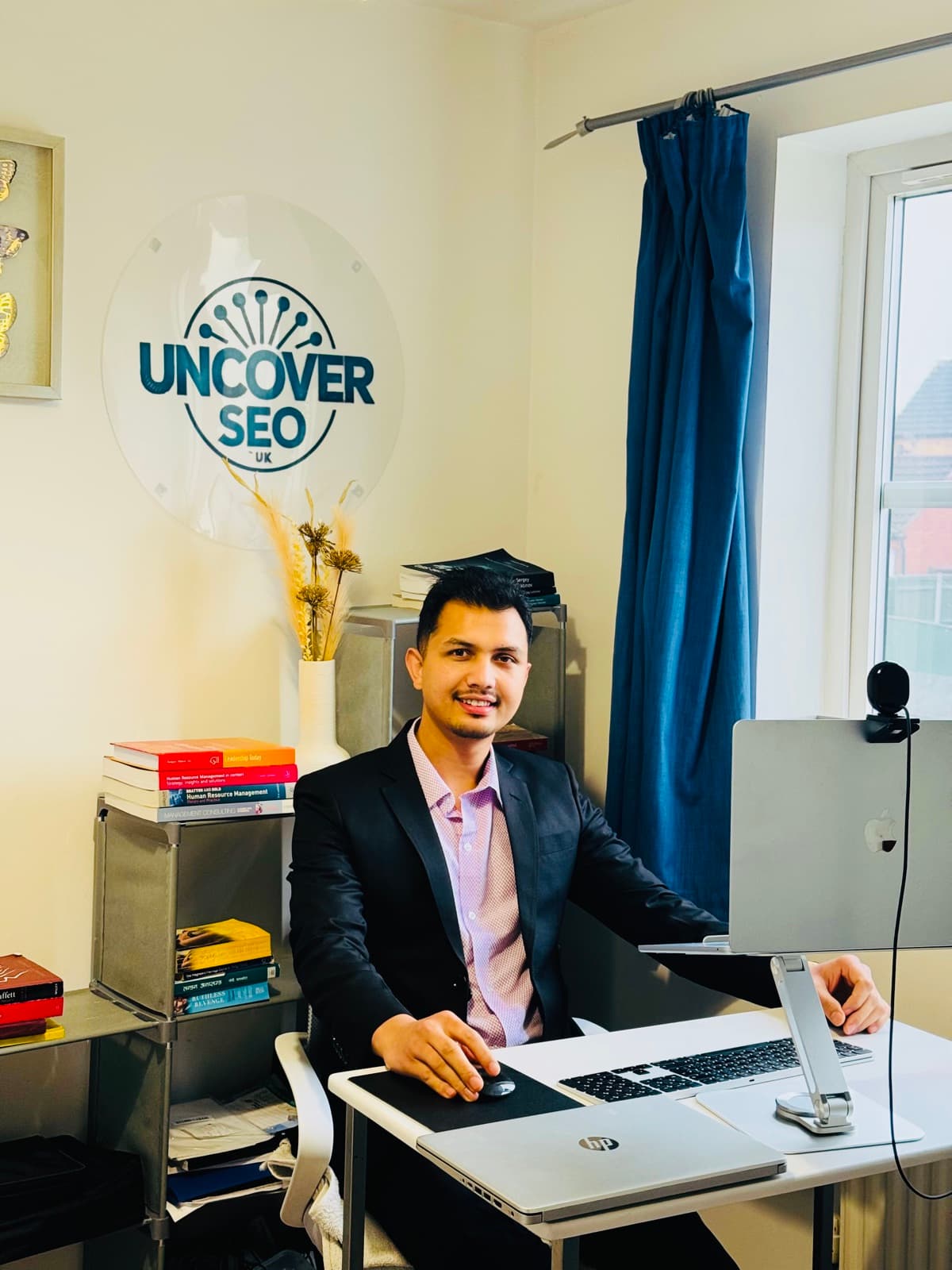
02/The shift in search
The search experience is expanding beyond traditional results pages. Businesses increasingly need to understand how search engines, AI systems and users interpret their brand.
Then
Now
Next
Search is no longer just about ranking pages. It’s about becoming understandable to machines, discoverable by people, and recommendable by AI.
03/Who I am
The route here wasn’t a straight line, and I don’t think it should have been.
I started in information technology — learning how systems structure, store and retrieve information. That turned out to be the right foundation for a field most people enter through marketing, because search is fundamentally a retrieval problem before it is a marketing one.
A marketing degree and Google-certified digital marketing training added the other half: how people actually decide, and what makes a business worth choosing. A master’s in leadership and management at the University of Wolverhampton reframed all of it again — visibility is a strategic question, not a channel tactic.
General digital marketing narrowed into SEO. SEO narrowed into Semantic SEO, after training in Koray Tuğbay Gürbüz’s methodology through Orca Social Academy and HolisticSEO.digital. That methodology is still the operating system behind how I work: entities, topical authority and semantic relationships rather than keyword lists.
I founded Uncover SEO to work on that properly. Today the work is pointed at one question in particular: helping brands get cited by AI search engines — AI visibility and Generative Engine Optimisation in the environments where people now ask rather than search. The research continues in public through Uncover SEO’s SEO Lab, where ideas get tested before they get recommended.
That same entity-first thinking is what led me to found Holistic Agent, a platform for UK small businesses to build AI agents — customer support, booking and lead qualification — that are genuinely useful rather than impressive in a demo. It also carries a free course on AI agents and automation, built on the same governed, engineered-system approach.
2015–2017
The technical foundation. Learning how systems store, structure and retrieve information — the same problem search engines solve at scale.
2017–2019
Formal marketing education alongside Google-certified digital marketing training. Technical understanding met the question of how people actually decide.
2019–2023
University of Wolverhampton, UK. Strategy, organisational thinking and the discipline of running something — not just executing within it.
2023–2026
Following advanced semantic SEO training through Orca Social Academy and HolisticSEO.digital — Koray Tuğbay Gürbüz’s methodology, which remains the operating system behind how Uncover SEO works.
2026
An AI agent platform for UK small businesses — customer support, booking and lead-qualification agents, built on the same entity-first, governed-system thinking as Uncover SEO’s Semantic SEO work.
Now
Running Uncover SEO and Holistic Agent, with the work pointed at the question that follows on from all of it: not just whether a brand ranks, but whether an AI system will name it in the answer.
04/What I've built
Uncover SEO is my consulting and experimentation environment focused on modern search visibility — Semantic SEO, entity authority engineering, and Generative Engine Optimisation (GEO).
Founder · Semantic SEO Consultant
Consulting · Experiments · Systems
AI Agents · UK Small Businesses
Product · Experimentation
05/My approach
Not a services grid. These are the six things I check before anything else, in roughly this order — because each one is worth very little without the one before it.
Who are you, what do you represent, and what does the market already associate with your brand? Everything else is downstream of that answer.
A connected information ecosystem rather than isolated content. Depth in a defined territory beats breadth across borrowed ones.
Make the relationships between entities, topics, content and audiences legible to machines — not just readable by people.
Build signals that exist beyond your own website. Self-declared authority is the weakest kind there is.
Search engines, local search, social platforms — Instagram, TikTok, LinkedIn, Facebook — digital PR, and AI systems. In the age of generative search, your presence on trusted social platforms is not optional; it is a retrieval source.
More on Social Media Optimisation →Discoverability and brand presence across modern search environments — because a rank position no longer describes the whole surface.
06/Semantic SEO
A search engine that can’t work out what your business is cannot decide when to recommend it. Semantic SEO is the work of making that answer unambiguous, structured as what I call the Entity-to-Visibility Stack — seven stages where each one only holds if the one before it does.
The thing itself — a brand, a person, a product, a place.
07/Social Media Optimisation
Social Media Optimisation is no longer a separate discipline. When AI systems answer questions, they increasingly cite social proof — reviews, verified profiles, trusted creators, community signals. Optimising your social presence is optimising your visibility in AI-powered search.
The same name, the same claims, the same facts — verified profiles and uniform branding everywhere your business appears, so no platform contradicts another.
See Semantic SEO →Reviews, engagement and cross-platform mentions. AI systems weigh these as evidence a brand is real and worth citing, not as vanity metrics.
Thought leadership, case studies and named frameworks — the kind of self-contained, citable content already published in Search Notes.
Read Search Notes →08/AI visibility
Users increasingly ask AI systems questions rather than only browsing traditional results. Which turns visibility into five separate questions, not one.
Are we being seen?
Are we being understood?
Are we trusted?
Are we being cited or used?
Are we generating business outcomes?
Most brands measure the first layer and fail at the second. Being seen is not the same as being understood — and only what is understood can be cited, trusted or recommended.
Tool
Traditional rankings tell only part of the story. Discover how your brand appears across modern search and AI environments.
Opens the AI Visibility Grader, built by Uncover SEO.
09/Selected work
Each panel follows the same shape: the problem, the approach, what was actually built, where it stands, and what it changed about how I work. Everything here exists — where there is no result yet, the panel says so.
Coming soon — the first Founding 10 case studies land after Month 3.
Coming soon — the first Founding 10 case studies land after Month 3.
First client results and case studies will appear here as Founding 10 businesses complete their first 90 days.
10/Search notes
I study search, run experiments, and publish what holds up. These are the positions I keep returning to — each one will become a full piece at its own URL.
Semantic SEO
Keywords describe what someone typed. Entities describe what exists. Only one of those survives a change in how people search.
Article in progress
AI Search
The query becomes a conversation, the result becomes an answer, and the click becomes optional. That changes what you optimise for.
Article in progress
Topical Authority
Publishing widely is not the same as owning a subject. Authority is structural before it is editorial.
Article in progress
AI Visibility
Visibility, interpretation, authority, AI inclusion, conversion. Most brands are failing at the second layer and measuring only the first.
Article in progress
11/The conversation
Whether you’re trying to build topical authority, improve organic visibility, understand AI search, or rethink your digital strategy — let’s talk.
→ Contact form on uncoverseo.com
→ Calendly · 30 minutes
→ wa.me · fastest response